


Dr. Yi Ge, MED-EL
Published Jul 29, 2026
Understanding the So-Called 4 Stages of Meniere’s Disease
The four stages of Ménière's disease describe how this chronic inner ear condition can affect hearing and balance over time. Ménière’s disease often causes recurring vertigo attacks, fluctuating hearing loss, tinnitus, and a feeling of fullness in the affected ear.

Symptoms can vary from person to person. The “four stages” of Ménière’s disease are a simplified way of describing how symptoms may change over time. Not everyone progresses through all four stages, some people remain relatively stable for many years, and symptoms from different stages may overlap.[1]
This is why the so-called stages of Ménière’s disease should be viewed as a general description of possible pattern of progression, not a fixed timeline that everyone follows the same way.
In this article, we explain the commonly described four stages of Ménière’s disease, how symptoms may change over time, what happens before, during, and between attacks, how the condition is diagnosed, and which treatment options may help with long-term management.
- 1 The 4 Stages of Ménière’s Disease
- 2 New or Changing Symptoms
- 3 How Long Do the Stages Last?
- 4 Before, During, and Between Attacks
- 5 Why Symptoms Change
- 6 How Is Ménière’s Disease Diagnosed?
- 7 Treatment and Long-Term Management
- 8 Hearing Support: Real-Life Experiences
- 9 Outlook and When to Seek Help
- 10 Key Takeaway
- 11 FAQs
Understanding The 4 Stages of Ménière’s Disease
- The four stages model is a commonly used framework for describing how Ménière’s disease symptoms may change over time.
- Early stages often involve vertigo, fluctuating hearing loss, tinnitus and aural fullness.
- Later stages may bring permanent hearing loss, tinnitus and imbalance.
- Symptoms may overlap or follow different patterns.
- Treatment options can help manage symptoms, but there is currently no cure.
Understanding the So-Called 4 Stages of Ménière’s Disease
Ménière’s disease is often described using four broad stages: early, middle, late, and advanced[2]. These stages are descriptive rather than diagnostic categories and are intended to illustrate common patterns of symptom progression. However, not everyone experiences all stages, and symptoms do not always follow a predictable sequence.
In the early stages of Ménière’s disease, symptoms often come and go. A person may have sudden vertigo attacks, tinnitus, ear pressure, and hearing changes that improve between episodes. In later stages, vertigo may become less frequent, but hearing loss, tinnitus, and balance problems may become more permanent.
Examples of symptom patterns commonly associated with the 4 stages model[3]:
| Stage | Vertigo | Hearing Loss | Tinnitus/ Fullness | Balance |
| Early | Sudden, intense attacks lasting 20 minutes to multiple hours | Fluctuating, may return to normal between episodes | Ringing and feeling of fullness in the ear | Usually normal between attacks |
| Middle | Still occurs, may become less frequent | More persistent and noticeable | More constant tinnitus and ear pressure | Mild imbalance may begin |
| Late | Less frequent or less severe | Significant and more permanent | Ongoing tinnitus and ear fullness | Persistent balance problems, often worse in the dark |
| Advanced (sometimes called a “Burnout” phase) | Rare or absent | Permanent, often severe hearing loss | Constant tinnitus and ear fullness | Ongoing imbalance, possible sudden falls (drop attacks) |
Important: This table illustrates common symptom patterns that may occur over time. Not everyone progresses through all four stages, and symptoms may overlap or follow a different course.
What Should You Do if Notice New or Changing Symptoms?
If you notice recurring vertigo attacks, fluctuating hearing loss, tinnitus, or ear fullness, arrange an assessment with an ENT specialist. Keeping a record of your symptoms, including when attacks occur and how long they last, can help support diagnosis and treatment decisions.
Stage 1: Early Stage
In the early stage of Ménière’s disease, symptoms often fluctuate and may appear unpredictably. Many people experience sudden vertigo attacks that make it feel as if the room is spinning, while others may first notice hearing changes, tinnitus, aural fullness, dizziness, or a sense of imbalance.
Hearing loss usually fluctuates at this stage. This means hearing in the affected ear may become muffled or reduced during an episode then improve again afterward. Some people also notice tinnitus, often described as a ringing, buzzing, roaring, or humming in the ear.
Another common early symptom is aural fullness, which can feel like pressure, blockage, or congestion in the affected ear. Because these symptoms may come and go, the early stage can be confusing. Some people may wonder whether stress, tiredness, migraines, ear infections, or other issues are causing their symptoms.
A useful step early on is to track symptoms. Writing down when vertigo attacks happen, how long they last, whether hearing changes occur, and whether tinnitus or ear fullness increases can help when speaking with a specialist.
Stage 2: Middle/Intermediate Stage
In the middle stage, symptoms may become more noticeable in daily life. However, not everyone experiences this stage in the same way, and some symptoms can overlap with those described in earlier or later stages.
Vertigo attacks may still happen, although some people find they become less frequent or less severe than in the early stage. Other people continue to experience unpredictable attacks.
Hearing loss may become more persistent instead of returning fully to normal between episodes. Tinnitus may also become more constant, and the feeling of fullness in the affected ear may last longer.
This stage can make communication more difficult. People may notice they have trouble hearing in background noise, following conversations in groups, or understanding speech on the affected side. Because the condition affects both hearing and balance, some people also begin to feel mildly unsteady between attacks.
Periods of remission can still happen. However, compared with the early stage, the symptoms may feel less “on and off” and more like an ongoing part of daily life.
Stage 3: Late Stage
In the late stage of Ménière’s disease, vertigo attacks often become less frequent or less severe. However, this does not always mean the condition has improved. Instead, the main difficulties may shift toward more permanent hearing loss and balance problems.
Hearing loss in the affected ear may become significant and more constant. Tinnitus may continue, and some people still experience ear fullness or pressure. Balance can also become more difficult, especially in low light, on uneven ground, or when tired.
In this stage, confidence and independence may be affected. Some people avoid crowded places, stairs, driving, or situations where a sudden balance problem could be dangerous. Support from an ENT specialist, audiologist, and balance therapist can help identify practical strategies for daily life.
Important: Reduced vertigo does not necessarily mean recovery. In later Ménière’s disease stages, long-term hearing and balance changes may remain even if vertigo attacks happen less often.
Stage 4: Advanced Stage (Sometimes Called “Burnout” Phase)
The advanced stage is sometimes called the burnout stage. It usually means vertigo attacks have reduced or stopped, while long-term inner ear damage remains. However, this pattern does not occur in everyone and is not considered as a universally defined stage of Meniere’s Disease.
At this stage, hearing loss in the affected ear may be permanent and severe. Tinnitus and ear fullness may also continue. Balance problems can remain because the inner ear may no longer send reliable balance signals.
Some people may also experience drop attacks, which are sudden falls without loss of consciousness or warning. These can create a serious injury risk and should always be discussed with a medical specialist.
Want More Practical Info About Hearing Health?
Sign up for our news and updates newsletter and be the first to hear about new MED-EL Blog articles on hearing health, hearing loss, and hearing solutions.
Get Free UpdatesHow Long Do the So-Called 4 Stages of Ménière’s Disease Last?
There is no fixed timeline for the four stages of Ménière’s disease. Some people experience fluctuating symptoms for many years, while others develop more persistent hearing loss or balance problems over time. Not everyone progresses through all four stages, and some people may experience symptoms associated with different stages at the same time.
Symptoms can vary considerably from person to person , and periods of remission are common. Rather than following a predictable schedule, the four-stage model is best understood as a simplified framework to describe how the condition may change over time rather than a pathway that everyone experiences. This is why regular follow-ups with an ENT specialist or audiologist are important to monitor symptoms and adjust treatment as needed.
What Happens Before, During, and Between Attacks?
Ménière’s disease symptoms often happen in episodes rather than being exactly the same every day. Many people describe a pattern of early warning signs, the active symptoms phase, and the recovery or remission period.
However, experiences vary widely. Some people notice clear warning signs before an attack, while others have little or no warning.
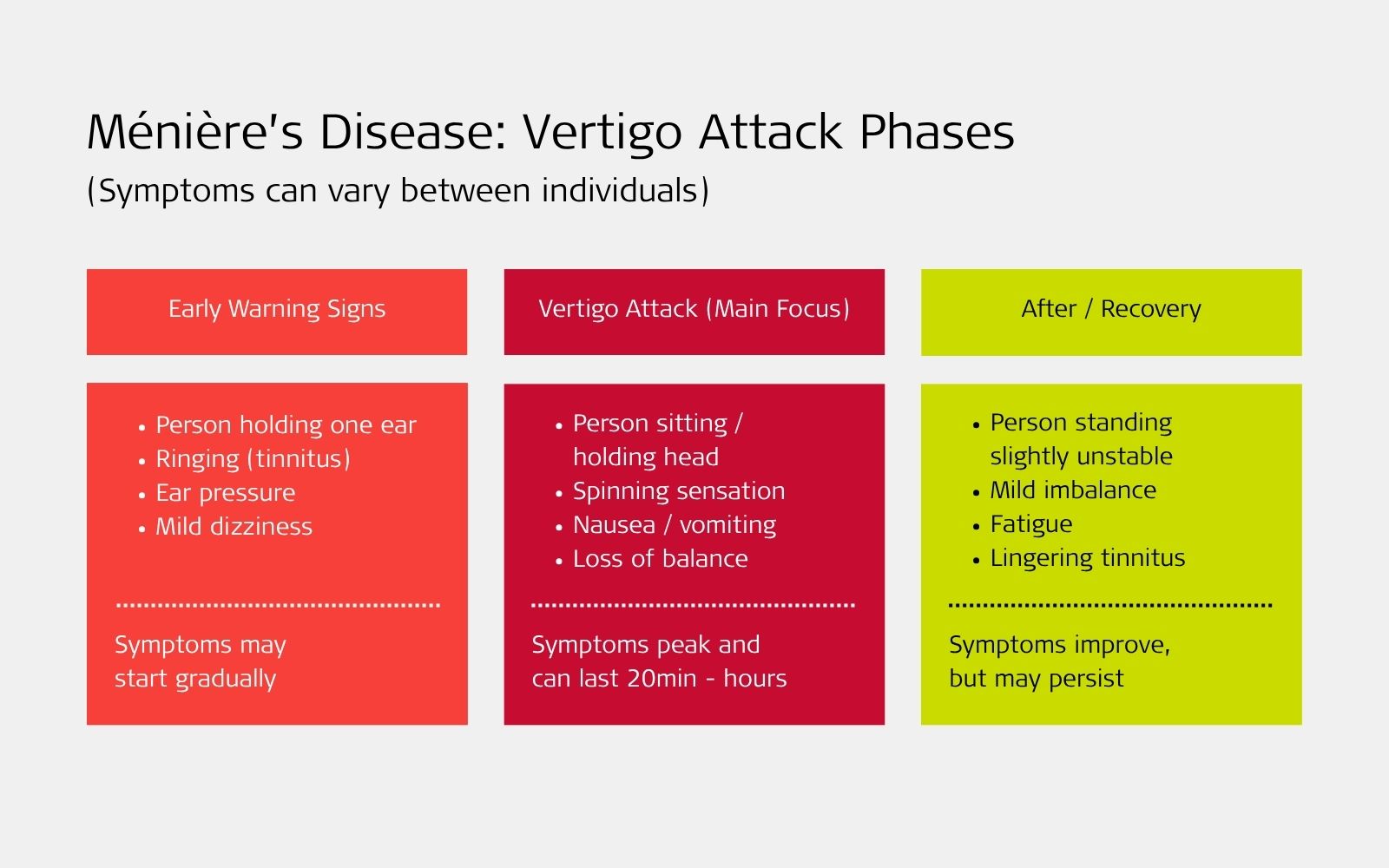
Early Warning Signs
Warning signs that some people notice before a vertigo attack include increased aural fullness in the affected ear, louder tinnitus, muffled hearing, mild dizziness, or a sense that balance is “off.”
These warning signs do not happen in everyone. But when they do, they may help a person move to a safer place, avoid driving, sit or lie down, and let someone nearby know what is happening.
During a Vertigo Attack
During a vertigo attack, it may feel as if the room is spinning or moving, even when the person is still. Attacks typically last 20 minutes to several hours and may be accompanied by nausea, vomiting, sweating or difficulty walking.
The safest response is usually to sit or lie down, avoid sudden head movements, and wait until the spinning sensation passes. If attacks are new, severe, frequent, or linked with sudden hearing changes, it is important to seek medical advice.
Between Episodes and Remission
Between attacks, some people feel almost normal. Others may have lingering fatigue, imbalance or a sense that their balance has not fully recovered, tinnitus, or hearing difficulty.
Symptoms can change over time and vary considerably between individuals. Hearing may fluctuate particularly earlier in the disease course, while the symptoms may become more persistent in some people. Periods of remission are also common and can last for months or even years.
This is one reason a symptom diary can be helpful. Tracking the frequency, length, and severity of attacks can support diagnosis and treatment planning.
Why Do Symptoms Change Over Time?
Ménière’s disease is linked to abnormal changes in fluid pressure inside the inner ear: endolymphatic hydrops. The inner ear contains delicate structures that help convert sound into hearing signals and movement into balance signals.
A simple way to imagine this is to think of the inner ear as a sensitive instrument. When fluid pressure changes, the signals for hearing and balance can become distorted. At first, this may cause symptoms that come and go. Over time, repeated disruption may affect the delicate hair cells and inner ear structures involved in hearing and balance.
This is why symptoms may shift from fluctuating hearing loss and vertigo attacks to more permanent hearing loss, tinnitus, and imbalance.
How Is Ménière’s Disease Diagnosed?
Ménière’s disease should be diagnosed by a qualified healthcare professional, usually an ENT specialist. There is no single test that confirms the condition in every case.
Diagnosis is usually based on a combination of symptoms, medical history, hearing tests, and ruling out other possible causes. Key factors that may contribute to diagnosis include:
- Recurrent episodes of vertigo or other vestibular symptoms
- Episodes that typically lasting at least 20 minutes
- Hearing loss shown on an audiogram
- Tinnitus or fullness in the affected ear
- Symptoms that affect hearing and balance
Because other conditions can also cause dizziness, tinnitus, or hearing loss, a specialist may check for other possible causes, such as migraine-related vertigo, vestibular neuritis, ear infections, neurological conditions, or other inner ear disorders.

Treatment Options and Long-Term Management
There is currently no cure for Ménière’s disease, but treatment can help manage symptoms, reduce safety risks, and improve quality of life.
Treatment is individualized and depends on the person’s symptoms, hearing levels, balance function, overall health, and the stage of the disease. Options may include:
Lifestyle and Safety Adjustments
Some people are advised to review their diet, manage stress, reduce personal triggers, or make safety changes at home and work.
Medication for Vertigo or Nausea
Medication may be used to help manage vertigo attacks, nausea, and vomiting. The right option depends on medical history and should be discussed with a healthcare professional.
Vestibular Rehabilitation
For chronic imbalance, vestibular rehabilitation may be recommended. This type of therapy is designed to reduce long-term balance problems, not to stop an acute vertigo attack while it is happening.
Hearing Support
When hearing loss becomes to affect daily communication, an ENT specialist or audiologist may discuss additional options. These may include hearing aids, CROS systems, bone conduction solutions, or a cochlear implant[4], depending on the person’s hearing test results and medical history.

Cochlear Implants
Explore Cochlear ImplantsHearing Support in Later Stages: Real-Life Experiences
Helen, an audiologist from Australia, experienced single-sided deafness due to Ménière’s disease. After receiving a MED-EL cochlear implant, she described the impact on her tinnitus:

“My MED-EL cochlear implant also silenced my tinnitus, which is really quite amazing and a huge relief.”
Helen
CI user from Australia
Helen’s experience shows why hearing support can be an important part of the conversation when Ménière’s disease leads to long-term, severe hearing loss. For some people, improved access to sound may also support confidence in daily activities, social situations, and increase personal independence.
Helen's Hearpeers Mentor Profile
Helen understands the journey to a hearing implant with Ménière's Disease and can help guide you through the process. Explore her profile and get in touch today.
Connect With HelenLong-Term Outlook and When to Seek Help
The long-term outlook for Ménière’s disease varies. Some people have occasional attacks with long symptom-free periods. Others develop more persistent hearing and balance difficulties.
Symptoms may stabilize but typically do not disappear completely. In some people, the condition may eventually affect both ears, but most people experience symptoms in only one ear.
You should seek medical advice if you experience:
- Sudden hearing loss
- Frequent vertigo attacks
- Severe nausea or vomiting
- Falls or drop attacks
- Symptoms affecting both ears
- Ongoing tinnitus or ear fullness
- Balance problems that affect daily safety
New or severe dizziness should always be assessed, especially if it is accompanied by symptoms such as weakness, speech difficulty, chest pain, severe headaches, or other urgent warning signs.
Key Takeaway
The so-called four stages of Ménière’s disease provide a useful framework for understanding how symptoms may progress over time. However, they should be viewed as general description of possible symptom patterns rather than a fixed pathway that everyone follows. Everyone’s experience is different, and the stages of Ménière’s disease should not be used as a self-diagnosis.
With the right medical support, many people can manage symptoms, reduce safety risks, and find hearing support when long-term hearing loss affects daily life.
If you are experiencing vertigo, tinnitus, ear fullness, or hearing changes, speak with an ENT specialist or hearing care professional to understand your symptoms and explore the next steps.
Take the Next Step
Ménière’s disease can change over time, and the right support depends on your symptoms, hearing levels, and balance concerns. Speak with your local MED-EL team to find out which hearing options could help.
Contact UsFAQs
No. Ménière’s disease progresses differently for everyone. Some people experience long periods of time with few symptoms, while others develop more permanent hearing loss or balance problems over time. Early diagnosis and treatment can help manage symptoms and improve quality of life.
There is no single best treatment for Ménière’s disease. Treatment depends on your symptoms and may include lifestyle changes, medication, vestibular rehabilitation, or hearing support. If hearing loss becomes permanent, your hearing specialist may recommend hearing aids or implantable hearing solutions.
There is no set timeline for the stages of Ménière’s disease. Some people stay in the early stage for years, while others progress more quickly. Symptoms often come and go, making the condition difficult to predict.
Common triggers include stress, high salt intake, caffeine, alcohol, lack of sleep, and illness. Triggers vary from person to person, so keeping a symptom diary can help you identify patterns and avoid future attacks.
Yes. In the early stages, hearing loss may come and go. Over time, however, it can become permanent. If hearing loss begins to affect daily life, an audiologist or ENT specialist can discuss hearing rehabilitation options, including hearing aids or cochlear implants in appropriate cases.
References
-
[1]
Huppert, D., Strupp, M., & Brandt, T. (2010). Long-term course of Menière’s disease revisited. Acta Oto-Laryngologica, 130(6), 644–651. https://doi.org/10.3109/00016480903382808
-
[2]
Young, Y. H., Huang, T. W., & Cheng, P. W. (2003). Assessing the stage of Meniere’s disease using vestibular evoked myogenic potentials. Archives of Otolaryngology–Head & Neck Surgery, 129(8), 815-818. https://doi.org/10.1001/archotol.129.8.815
-
[3]
Sobhy, O. A., Elmoazen, D. M., & Abd-Elbaky, F. A. (2019). Towards a new staging of Ménière’s disease: a vestibular approach. Acta Otorhinolaryngologica Italica, 39(6), 419. https://doi.org/10.14639/0392-100X-2461
-
[4]
Berardino, F. D., Conte, G., Turati, F., Ferraroni, M., & Zanetti, D. (2020). Cochlear implantation in Ménière’s disease: a systematic review of literature and pooled analysis. International Journal of Audiology, 59(6), 406–415. https://doi.org/10.1080/14992027.2020.1720922
References


Dr. Yi Ge
Dr. Yi Ge is a certified otolaryngologist. Since joining MED-EL in 2003, she has held various roles across clinical, regulatory, and medical affairs. Currently, Dr. Ge serves as the Senior Manager of Medical Affairs at MED-EL Innsbruck. Her work focuses on medical process assessment in support of product development and risk management. With deep knowledge of hearing implant systems and global regulatory requirements, Dr. Ge fosters patient-centered innovation in hearing healthcare.
MED-EL



Was this article helpful?
Thanks for your feedback.
Sign up for newsletter below for more.
Thanks for your feedback.
Please leave your message below.
Thanks for your message. We will reply as soon as possible.
Send us a message
Field is required
John Doe
Field is required
name@mail.com
Field is required
What do you think?
© MED-EL Medical Electronics. All rights reserved. The content on this website is for general informational purposes only and should not be taken as medical advice. Contact your doctor or hearing specialist to learn what type of hearing solution suits your specific needs. Not all products, features, or indications are approved in all countries.
Richard Grzybowski
July 29, 2026
Excellent article. As a person deeply affected by Meniere for the past 50 years I feel justified to comment. Frankly, bilateral cochlear implants helped, if not completely alleviated all of the symptoms, vertigo being the most unpleasant and disruptive.
MED-EL
July 30, 2026
Richard, thank you so much for sharing your experience with bilateral cochlear implants, and how they helped you. Kind Regards
Dr. Yi Ge
Dr. Yi Ge is a certified otolaryngologist. Since joining MED-EL in 2003, she has held various roles across clinical, regulatory, and medical affairs. Currently, Dr. Ge serves as the Senior Manager of Medical Affairs at MED-EL Innsbruck. Her work focuses on medical process assessment in support of product development and risk management. With deep knowledge of hearing implant systems and global regulatory requirements, Dr. Ge fosters patient-centered innovation in hearing healthcare.
MED-EL
Dr. Yi Ge
Dr. Yi Ge is a certified otolaryngologist. Since joining MED-EL in 2003, she has held various roles across clinical, regulatory, and medical affairs. Currently, Dr. Ge serves as the Senior Manager of Medical Affairs at MED-EL Innsbruck. Her work focuses on medical process assessment in support of product development and risk management. With deep knowledge of hearing implant systems and global regulatory requirements, Dr. Ge fosters patient-centered innovation in hearing healthcare.
MED-EL
Conversation
1 Comment