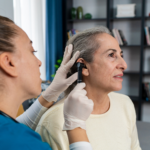
And you can't even see it.
Discover TICI

Dr. Yi Ge, MED-EL
Published Aug 11, 2025
If voices sound muffled or you can’t hear birds chirping or doorbells ringing, you might be experiencing high-frequency hearing loss. Learn what causes it, how to spot the signs, and what treatments can help you reconnect with the sounds you’ve been missing.
The normal speech frequency range typically spans from 250 Hz to 8000 Hz. High-frequency hearing loss refers to difficulty in hearing sounds in the higher pitch range, typically between 2,000 and 8,000 Hz. This condition can make understanding speech challenging, especially in noisy environments, as it affects the perception of high-frequency consonants like “s,” “f,” and “th.”
While it is more common High-frequency hearing loss can have a variety of causes:
In many cases, high-frequency sensorineural hearing loss worsens over time and is not noticed immediately.
The first symptoms of high-frequency deafness are usually subtle. Many people notice that they have difficulty hearing certain consonants clearly. Conversations—especially in groups—become difficult to understand. And high frequencies seem to disappear.
These are some typical signs of high-frequency hearing loss:
Important: High frequencies (above 2000 Hz) tend to be affected by age-related hearing loss first.
Try our free online hearing test to find out whether you have hearing loss. This test can provide you with a quick assessment of how well you can hear and communicate in everyday life.
Test Your HearingEarly diagnosis is important in order to reduce the risk of additional related problems, such as tinnitus or social withdrawal. There are individual treatment options for the various levels of hearing loss, from hearing aids to hearing implants.
Going to the ENT (ear, nose, and throat) doctor is the first step. They will perform an audiogram, a hearing curve that shows at which frequencies you have hearing loss. Additionally, speech audiometry can be used to evaluate speech understanding at different volumes.
For individuals with hearing loss that affects high frequencies, there are special hearing aids that specifically target and amplify high pitches. And modern hearing systems can even filter out background noise to improve speech understanding.
Treatment Options:
The best way to lower your risk of high-pitch hearing loss is prevention
Many people have high-frequency hearing loss. And many of them don’t even realize it. If you’re missing out on high pitches or can no longer understand some consonants, it’s time for a hearing test. With an early diagnosis and modern technology, you can get back to hearing clearly again.
References
Dr. Yi Ge
Dr. Yi Ge is a certified otolaryngologist. Since joining MED-EL in 2003, she has held various roles across clinical, regulatory, and medical affairs. Currently, Dr. Ge serves as the Senior Manager of Medical Affairs at MED-EL Innsbruck. Her work focuses on medical process assessment in support of product development and risk management. With deep knowledge of hearing implant systems and global regulatory requirements, Dr. Ge fosters patient-centered innovation in hearing healthcare.
MED-EL
Was this article helpful?
Thanks for your feedback.
Sign up for newsletter below for more.
Thanks for your feedback.
Please leave your message below.
Thanks for your message. We will reply as soon as possible.
Send us a message
Field is required
John Doe
Field is required
name@mail.com
Field is required
What do you think?
© MED-EL Medical Electronics. All rights reserved. The content on this website is for general informational purposes only and should not be taken as medical advice. Contact your doctor or hearing specialist to learn what type of hearing solution suits your specific needs. Not all products, features, or indications are approved in all countries.
Dr. Yi Ge
Dr. Yi Ge is a certified otolaryngologist. Since joining MED-EL in 2003, she has held various roles across clinical, regulatory, and medical affairs. Currently, Dr. Ge serves as the Senior Manager of Medical Affairs at MED-EL Innsbruck. Her work focuses on medical process assessment in support of product development and risk management. With deep knowledge of hearing implant systems and global regulatory requirements, Dr. Ge fosters patient-centered innovation in hearing healthcare.
MED-EL
Dr. Yi Ge
Dr. Yi Ge is a certified otolaryngologist. Since joining MED-EL in 2003, she has held various roles across clinical, regulatory, and medical affairs. Currently, Dr. Ge serves as the Senior Manager of Medical Affairs at MED-EL Innsbruck. Her work focuses on medical process assessment in support of product development and risk management. With deep knowledge of hearing implant systems and global regulatory requirements, Dr. Ge fosters patient-centered innovation in hearing healthcare.
MED-EL
Want to make sure you get all the latest articles from the MED-EL Blog? Subscribe now!
Registration was successful
We’re the world’s leading hearing implant company, on a mission to help people with hearing loss experience the joy of sound.
Find your local MED-EL team
© MED-EL Medical Electronics. All rights reserved. The content on this website is for general informational purposes only and should not be taken as medical advice. Contact your doctor or hearing specialist to learn what type of hearing solution suits your specific needs. Not all products, features, or indications are approved in all countries.